Philosophy · A free classic

Discourse on the Method in plain English

Doubt everything, then rebuild from one certainty

Free in Clarify · The full book, with help where it’s hard

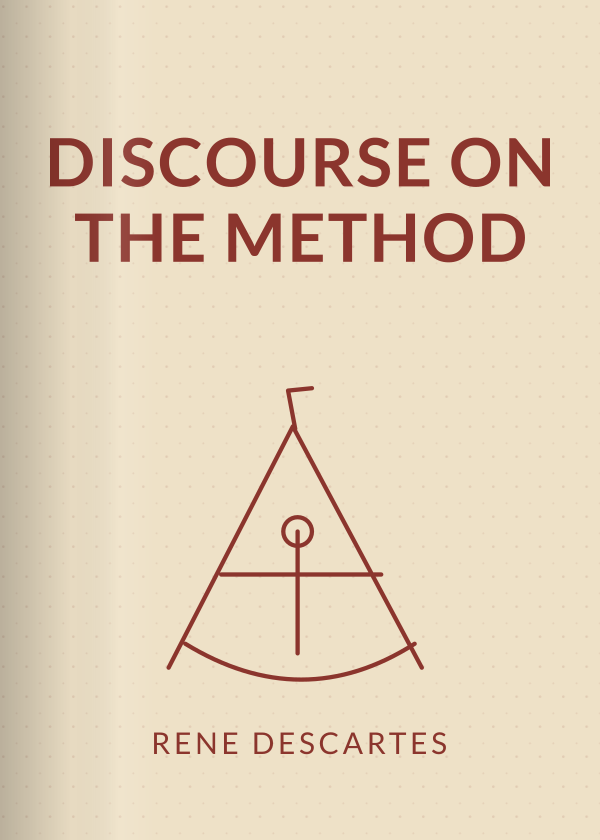
Discourse on the Method coverThe real book. A clearer way through it.

A page from the book

Read it in plain English.

The same passage, with the language made clearer. Read the full book this way in Clarify.

Original

Part IVTranslated by John Veitch

But immediately upon this I observed that, whilst I thus wished to think that all was false, it was absolutely necessary that I, who thus thought, should be somewhat; and as I observed that this truth, I think, therefore I am (COGITO ERGO SUM), was so certain and of such evidence that no ground of doubt, however extravagant, could be alleged by the sceptics capable of shaking it, I concluded that I might, without scruple, accept it as the first principle of the philosophy of which I was in search.
In Clarify

Clarify’s plain-English version · Generated by AI

But right away I noticed something. While I was trying to think that everything was false, I myself, the one doing the thinking, had to be something. So I saw that this truth, I think, therefore I am (COGITO ERGO SUM), was so certain and so clearly supported that even the most extreme doubts of the skeptics could not shake it. I concluded that I could accept it without hesitation as the first principle of the philosophy I was searching for.

The book behind the language

About the book

René Descartes published Discourse on the Method in 1637. Written in French, it introduces a way of directing inquiry through careful judgment, dividing problems and moving from simpler matters to more complex ones. Descartes presents the method through a personal account of his education, travels and decision to reconsider beliefs he had accepted.

The best-known moment comes when doubt itself supplies a starting point: thinking requires the existence of the thinker. The work also discusses morals, God, nature and the aims of scientific research. It became an important statement of modern philosophy's search for secure foundations. Reading the full text shows how its famous certainty fits into a wider project of inquiry and practical knowledge.

Help where it’s hard

How Clarify helps

Stay with Discourse on the Method. Get help with the words and ideas as you read.

Simplify as you read.

Turn on Simplify for clearer prose throughout the book. Or select one sentence and tap Simplify.

Keep the original close.

Tap the eye icon on a simplified paragraph to see the original. It’s always one tap away.

Understand the idea.

Select a sentence and tap Explain for help with what it means. Then carry on reading.

Quick facts

Length
About 60 pages
Difficulty
Hard
Date
1637
Category
Philosophy

Before you start

A few good questions.

Is there an easier version of Discourse on the Method?

Yes. Clarify keeps the full text of Discourse on the Method and lets you read it in plain English. Tap the eye icon to see the original, always one tap away.

Can I read Discourse on the Method for free?

Yes. Read the full book in Clarify's free library on Android, iPhone and iPad. There is no paid tier and no account to create.

What does 'I think, therefore I am' mean?

Descartes notices that even if he doubts everything, the act of doubting requires him to exist as a thinker. He takes that as a certainty that doubt itself cannot undermine. It is a starting point for his inquiry, rather than a claim that thinking makes a person physically appear.

Read the whole book

Start with a page.
Keep going with Clarify.

Find Discourse on the Method in Discover’s 145 free classics, or open your own EPUB. Free on Android, iPhone and iPad. No paid tier. No account.