Philosophy · A free classic

Nicomachean Ethics in plain English

The original guide to a happy life

Read Nicomachean Ethics free in plain English

Free in Clarify · The full book, with help where it’s hard

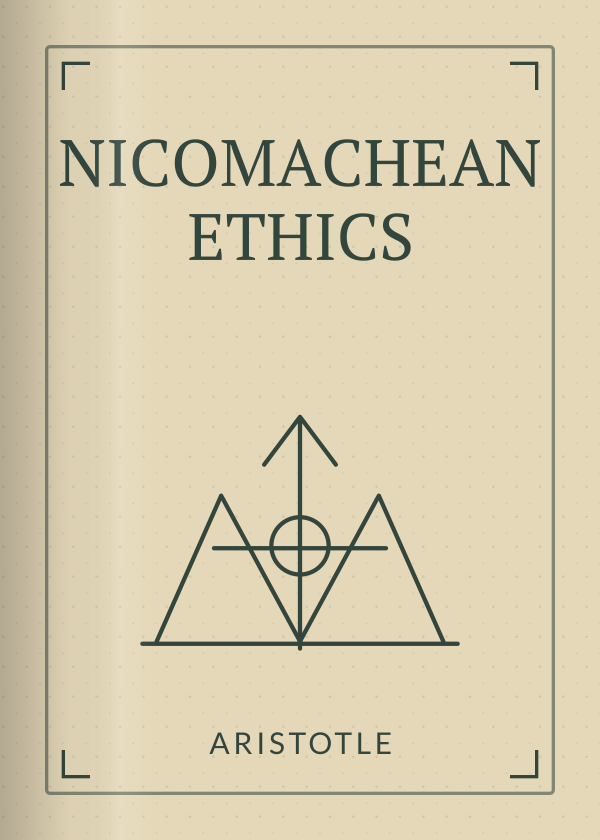
Nicomachean Ethics coverThe real book. A clearer way through it.

A page from the book

Read it in plain English.

The same passage, with the language made clearer. Read the full book this way in Clarify.

Original

Book I, openingTranslated by D. P. Chase

Every art, and every science reduced to a teachable form, and in like manner every action and moral choice, aims, it is thought, at some good: for which reason a common and by no means a bad description of the Chief Good is, “that which all things aim at.”
In Clarify

Clarify’s plain-English version · Generated by AI

Every art and every science that has been turned into a teachable form aims at some good. The same is true of every action and every moral choice. People think so, anyway. For this reason, a common and not at all bad description of the Chief Good (the highest good, the one final aim of human life) is this: “that which all things aim at.”

The book behind the language

About the book

Written in the fourth century BC, Aristotle's Nicomachean Ethics asks what makes a human life go well. Its answer centers on eudaimonia, often translated as happiness or flourishing. Aristotle treats this as a way of living and acting over a whole life, rather than a pleasant feeling that comes and goes.

He examines character, choice, friendship, pleasure and practical judgment. Virtue develops through practice, but knowing what to do also requires attention to the circumstances. The book became a central work of moral philosophy and remains important to approaches that begin with character rather than rules alone. Its everyday examples make room for difficult questions about what we should want and how we learn to want it.

Help where it’s hard

How Clarify helps

Stay with Nicomachean Ethics. Get help with the words and ideas as you read.

Simplify as you read.

Turn on Simplify for clearer prose throughout the book. Or select one sentence and tap Simplify.

Keep the original close.

Tap the eye icon on a simplified paragraph to see the original. It’s always one tap away.

Understand the idea.

Select a sentence and tap Explain for help with what it means. Then carry on reading.

Quick facts

Length
About 320 pages
Difficulty
Very hard
Date
c. 340 BC
Category
Philosophy

Before you start

A few good questions.

Is there an easier version of Nicomachean Ethics?

Yes. Clarify keeps the full text of Nicomachean Ethics and lets you read it in plain English. Tap the eye icon to see the original, always one tap away.

Can I read Nicomachean Ethics for free?

Yes. Read the full book in Clarify's free library on Android, iPhone and iPad. There is no paid tier and no account to create.

What does Aristotle mean by happiness?

Aristotle's eudaimonia means a life that goes well as a whole, often called flourishing. It involves activity guided by virtue, rather than simply feeling pleased. He also recognizes that friendship and some external goods matter to living well.

Read the whole book

Start with a page.
Keep going with Clarify.

Find Nicomachean Ethics in Discover’s 145 free classics, or open your own EPUB. Free on Android, iPhone and iPad. No paid tier. No account.