Politics and society · A free classic

The Communist Manifesto in plain English

"A spectre is haunting Europe": the pamphlet that shaped the 20th century

Free in Clarify · The full book, with help where it’s hard

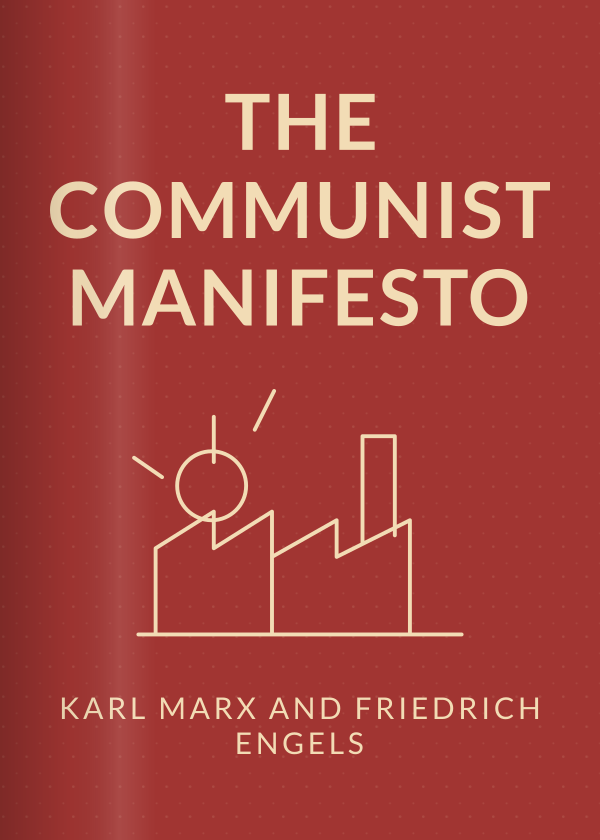
The Communist Manifesto coverThe real book. A clearer way through it.

A page from the book

Read it in plain English.

The same passage, with the language made clearer. Read the full book this way in Clarify.

Original

Section I, openingTranslated by Samuel Moore

The history of all hitherto existing societies is the history of class struggles.

Freeman and slave, patrician and plebeian, lord and serf, guild-master and journeyman, in a word, oppressor and oppressed, stood in constant opposition to one another, carried on an uninterrupted, now hidden, now open fight, a fight that each time ended, either in a revolutionary re-constitution of society at large, or in the common ruin of the contending classes.
In Clarify

Clarify’s plain-English version · Generated by AI

The history of every society that has existed until now is the history of class struggles.

Freemen and slaves, patricians and plebeians, lords and serfs, guild masters and journeymen stood in constant opposition to one another. In a word, the oppressors and the oppressed were always at odds. They carried on a fight that never stopped. Sometimes the fight was hidden, and sometimes it was open. Each time, it ended in one of two ways. Either society was rebuilt from the ground up through revolution, or the contending classes were both destroyed.

The book behind the language

About the book

Karl Marx and Friedrich Engels published The Communist Manifesto in 1848, on the eve of revolutions across Europe. Written for the Communist League, it presents history through conflicts between social classes and argues that capitalism creates a struggle between owners of capital and wage workers. Its account combines an analysis of economic change with a call for political action.

The pamphlet describes capitalism as a force that transforms production and social life, while arguing that it also creates conditions for its own overthrow. It became a defining text of communist movements and a lasting focus of political debate. Reading all its sections helps distinguish its historical argument, immediate proposals and criticism of rival socialist ideas.

Help where it’s hard

How Clarify helps

Stay with The Communist Manifesto. Get help with the words and ideas as you read.

Simplify as you read.

Turn on Simplify for clearer prose throughout the book. Or select one sentence and tap Simplify.

Keep the original close.

Tap the eye icon on a simplified paragraph to see the original. It’s always one tap away.

Understand the idea.

Select a sentence and tap Explain for help with what it means. Then carry on reading.

Quick facts

Length
About 50 pages
Difficulty
Challenging
Date
1848
Category
Politics and society

Before you start

A few good questions.

Is there an easier version of The Communist Manifesto?

Yes. Clarify keeps the full text of The Communist Manifesto and lets you read it in plain English. Tap the eye icon to see the original, always one tap away.

Can I read The Communist Manifesto for free?

Yes. Read the full book in Clarify's free library on Android, iPhone and iPad. There is no paid tier and no account to create.

What do 'bourgeoisie' and 'proletariat' mean?

In the Manifesto, the bourgeoisie are the class that owns the means of production, such as factories and capital. The proletariat are wage workers who must sell their labor to live. Marx and Engels argue that the relationship between these classes drives conflict within capitalism.

Read the whole book

Start with a page.
Keep going with Clarify.

Find The Communist Manifesto in Discover’s 145 free classics, or open your own EPUB. Free on Android, iPhone and iPad. No paid tier. No account.